
Members! customer manual#
Applies to: Members! 2.0 (Unreleased)
Audience: studio owners, administrators, and front-desk staff
Manual status: updated source; public preview awaiting publication
Members! is an iPhone and iPad app for managing members, memberships, classes, bookings, attendance, supported payments, and member QR cards.
Members! is currently a pre-release product. Complete device, printer, payment, server, backup, and migration checks before using it with real customer data.
Contents#
- Before you start
- First setup
- Move around Members!
- Membership plans
- Members and memberships
- Classes and bookings
- Check-in
- Member Mode on iPad
- QR cards, Apple Wallet, and printing
- Payments
- Reports and CSV exports
- Data and privacy
- Troubleshooting
- Support
Before you start#
You need:
- an iPhone with iOS 26 or an iPad with iPadOS 26;
- camera access for QR scanning and photos;
- an iPad passcode, Touch ID, or Face ID before using Member Mode;
- a configured SumUp account and compatible terminal only if you charge through the integrated SumUp flow;
- a compatible Epson or Star receipt printer, or an Apple system printer, if you print member cards.
Members! stores its operating data locally on the device. The local app remains usable if internet access is interrupted. Online staff sign-in, synchronization, and real Apple Wallet passes require the secure Members! server, which is not yet a deployed production service.
Before a live rollout, agree who owns the device, backups, access control, payment account, printer support, and customer support.
You do not need SumUp to save a membership with a manually recorded payment or with payment still due. Manual recording does not move money.
First setup#
Complete the following in order:
- Open Today, then select Settings.
- Under Studio, enter the studio name and choose EUR, GBP, or USD as the default currency.
- Under Check-in cameras, choose whether the rear owner scanner should stay active while staff use other parts of the app.
- Create the membership plans the studio sells.
- Open Classes > Class setup and add reusable class names, teachers, and rooms.
- If you will charge through Members!' integrated SumUp flow, connect the merchant account under Settings > SumUp payments.
- If receipt printing is required, configure and test an Epson or Star printer under Settings > Printing.
- Configure the secure Members! server and staff sign-in only when a production server address and owner bootstrap code have been supplied.
Move around Members!#
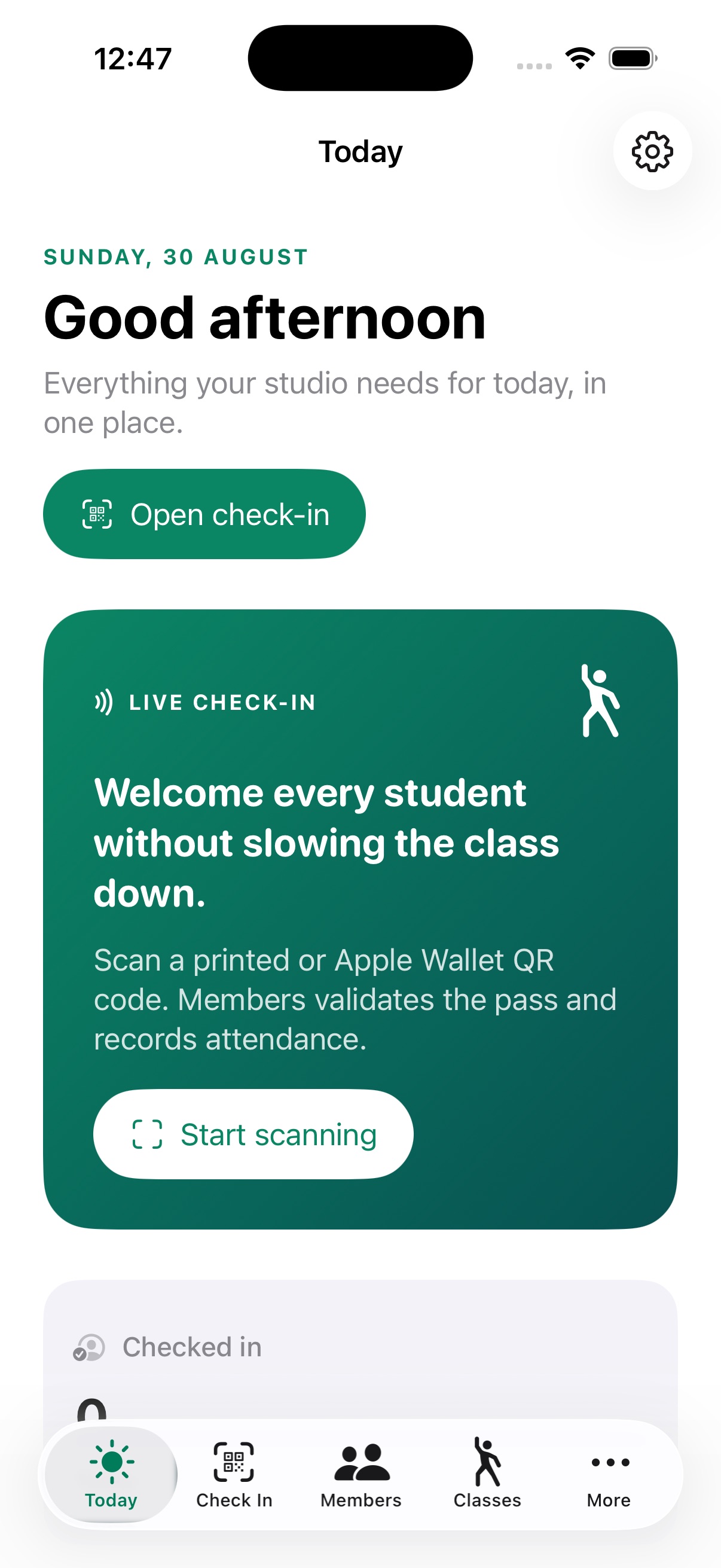
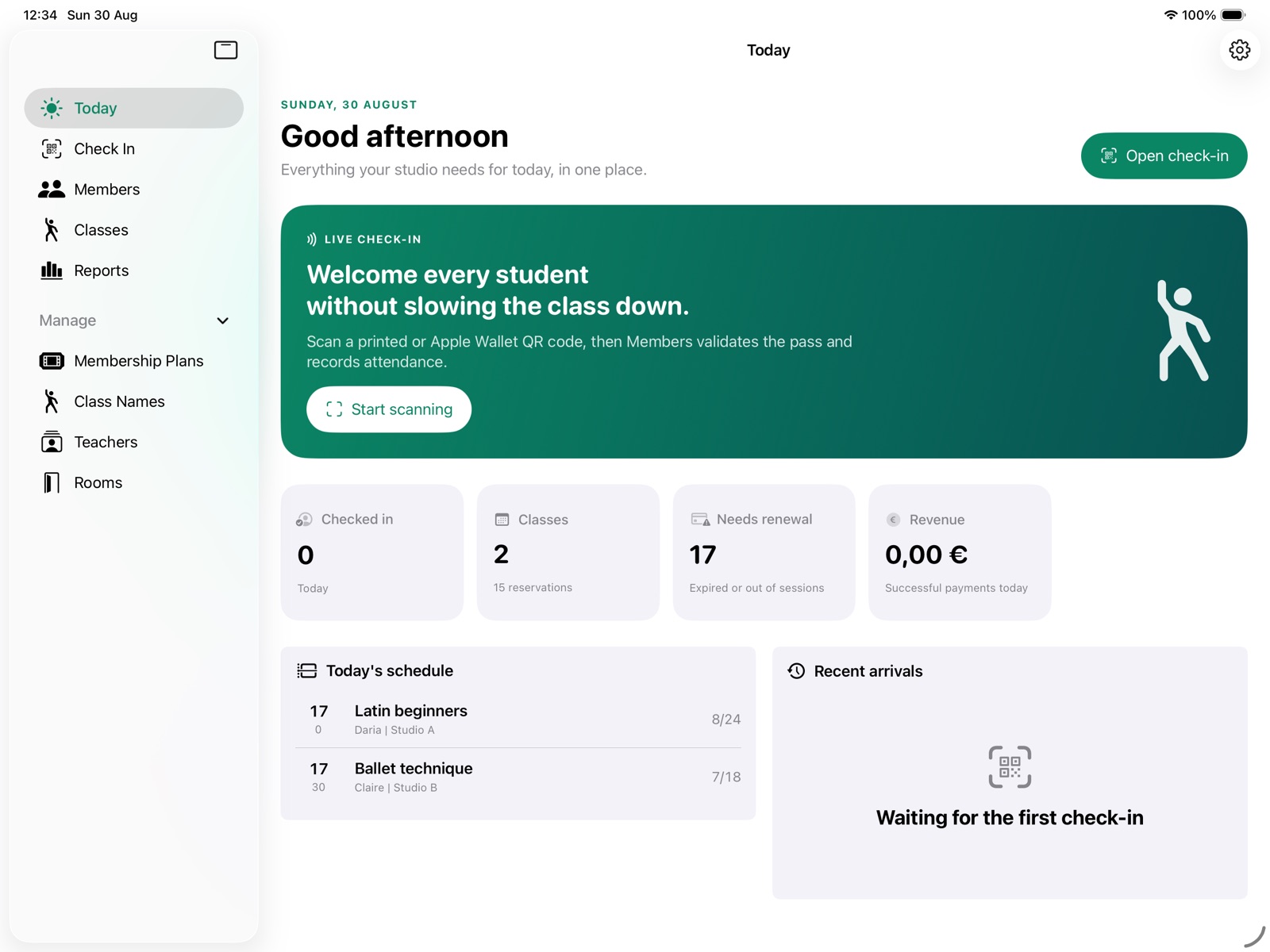
- Today shows today's check-ins, classes, renewals, collected payments, schedule, and recent arrivals.
- Check In scans or enters member codes and can attach attendance to a selected class.
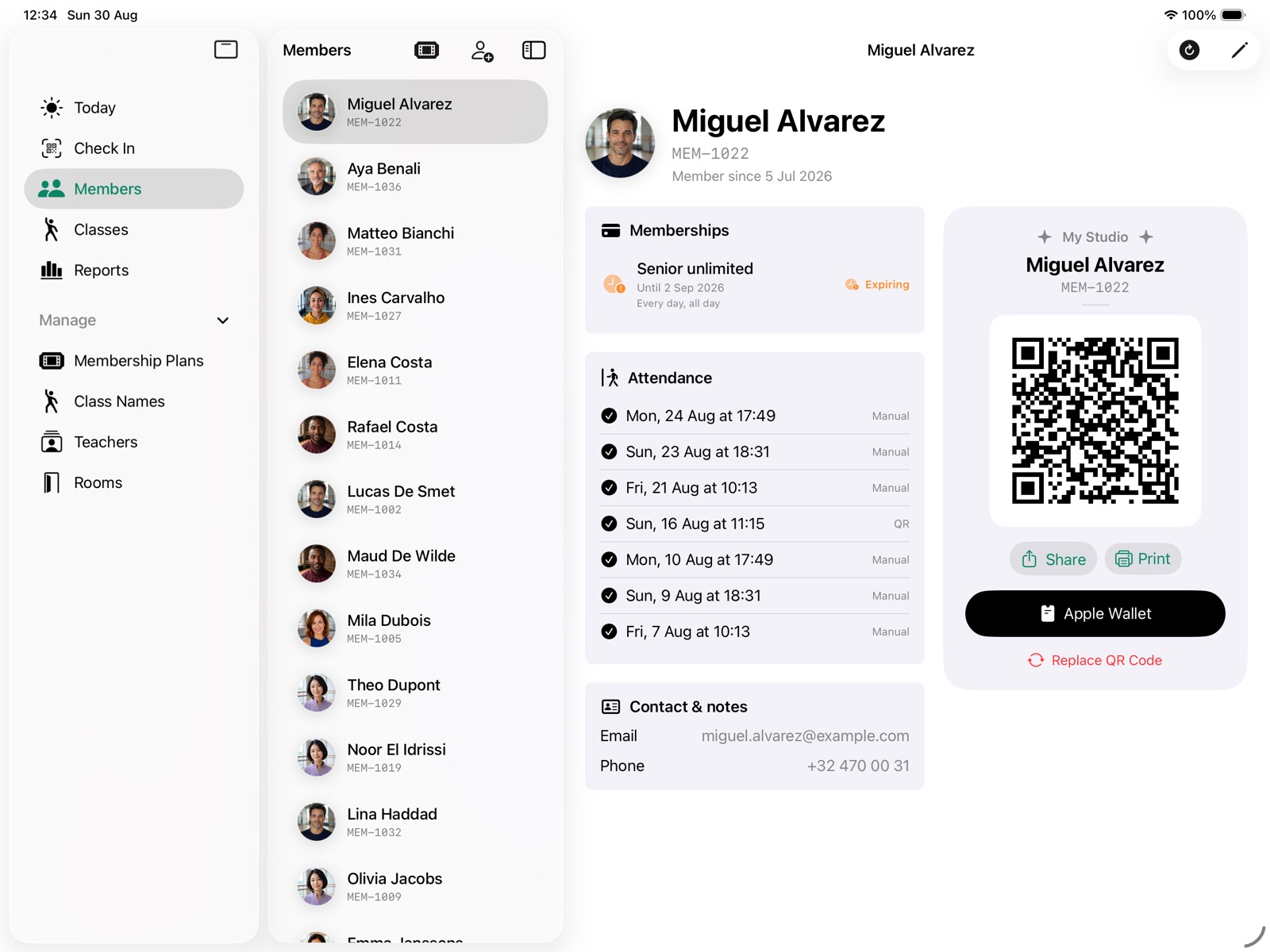
- Members stores member profiles, memberships, attendance, QR cards, and Wallet access.
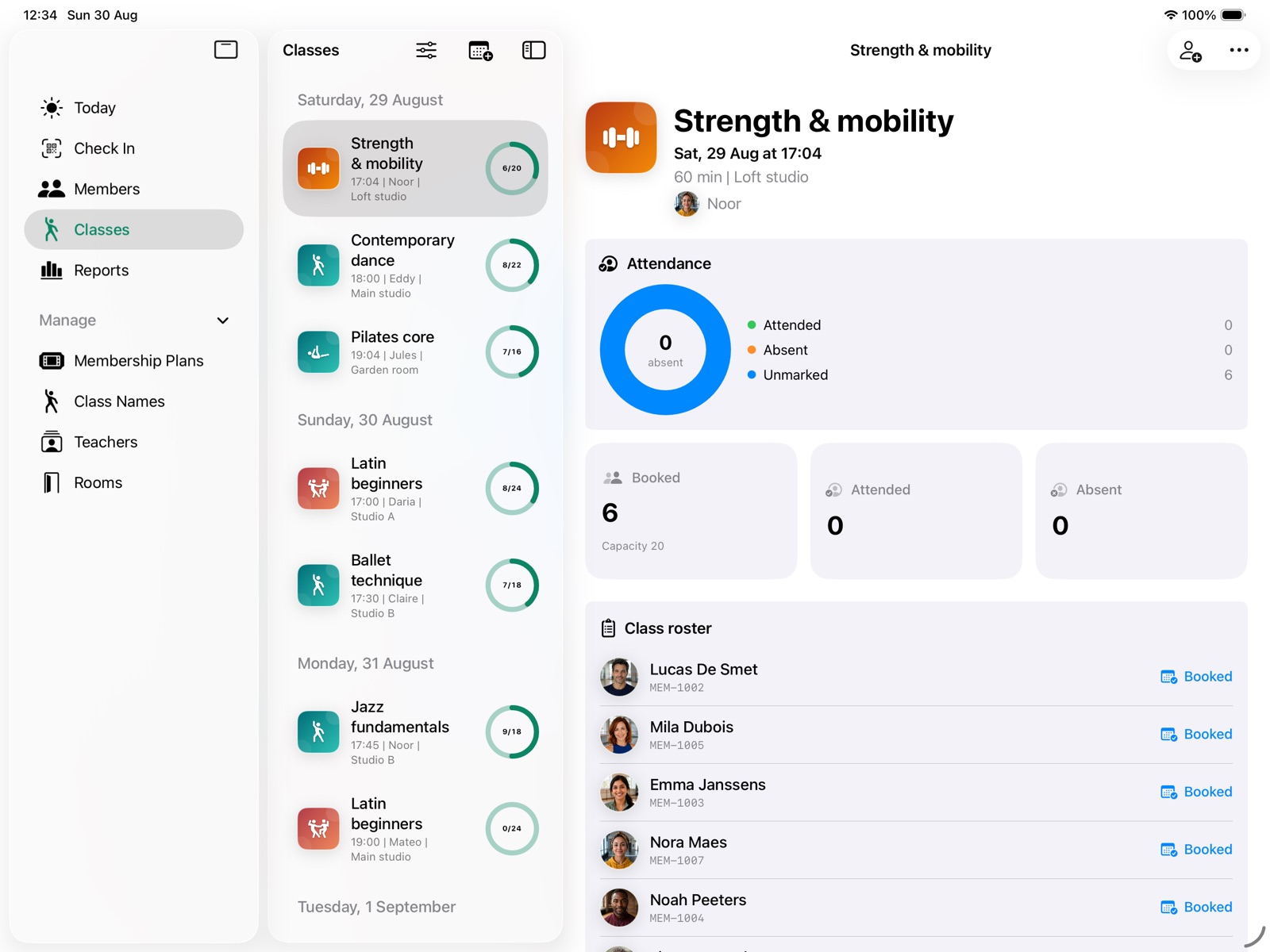
- Classes manages the timetable, bookings, attendance, teachers, rooms, and recurring sessions.
- Reports shows attendance, collected payments, outstanding balances, membership health, and class, teacher, and room performance.
- On iPad, open Manage > Payments in the sidebar for the payment ledger. The sidebar also provides Membership Plans, Class Names, Teachers, and Rooms.
- On iPhone, open Reports and select Payments to open the same ledger.
Screenshots in this guide use fictional demo data and may show earlier preview layouts. Follow the current workflow instructions below for memberships and payments.
Membership plans#
Create plans before selling or assigning memberships.
- Open Members and select Membership plans, or use Manage > Membership Plans on iPad.
- Select New plan.
- Enter the plan name and, if useful, an audience such as “65+” or “Under 18”.
- Choose Unlimited or Session pack.
- Set the price, currency, validity period, and number of visits for a session pack.
- Set weekday and weekend access. At least one must be enabled. Access times may cross midnight.
- Select Save.
Editing a plan does not rewrite memberships already sold. Open an existing plan and turn off Available to sell to stop future sales while preserving previously purchased memberships.
Delete or archive a plan#
Open a plan and select Delete Membership Plan. Members! permanently deletes it only when no membership refers to it and no card payment is still in progress. Otherwise select Archive Membership Plan. Archiving stops future sales while preserving existing memberships and payment history.
Members and memberships#
Add a member#
- Open Members and select Add member.
- Enter first name, last name, and a unique member code.
- Add contact information and notes if needed.
- Optionally add a photo with the camera, paste an image, or copy the current image.
- Select Save.
Use search to find a member by name or member code. Open a profile and select Edit member to update it. Turning off Active member prevents check-in without deleting the member's history.
Delete or archive a member#
Open a member profile, select More, then select Delete Member. A member can be permanently deleted only when they have no memberships, bookings, attendance records, or payments. Otherwise select Archive Member. Archiving keeps their records, makes the profile inactive, and prevents check-in and new membership sales.
Sell or assign a membership#
- Open the member profile.
- Select Add membership, including when renewing an existing plan.
- Choose an available plan and check the purchased terms.
- Confirm the start date. An unlimited renewal of the same plan is suggested to start when the current one expires so paid time is not lost.
- Choose Paid now or Pay later.
- For Paid now, select a payment method. Use SumUp to charge the connected terminal, or record a payment already received by another method. For Pay later, choose Due on and select Save as unpaid.
Manual methods work without a SumUp connection. Record Paid on, an optional reference, and any note. Other requires a note. The membership activates when the payment is recorded; Complimentary activates it without adding money to Collected. A SumUp purchase activates only after SumUp confirms payment. Members! stores payment status and references, not card details.
Pay later saves the membership and its outstanding balance together. While Payment due, it cannot be used for check-in and does not grant usable Wallet access. The member's other usable memberships remain available.
An ordinary unpaid balance does not prevent adding another membership. An unresolved SumUp payment must be reviewed before starting another purchase for that member.
If a SumUp payment needs review, do not charge again. Open its record in Payments and follow the recovery instructions below.
A member can hold more than one membership; use Add membership for each additional plan. In staff check-in, when more than one membership is usable now, choose which one to use. Only the chosen membership is used, and one visit is deducted if it is a session pack. With one usable membership, check-in proceeds directly. Member Mode continues to choose the usable membership that expires first automatically. Previously sold terms remain attached to each membership even if its plan is later edited.
Classes and bookings#
Prepare reusable class details#
Open Classes > Class setup to manage:
- Class names, including a photo or activity artwork, default duration, and notes;
- Teachers, including contact details and an optional photo;
- Rooms, including one default room.
Items marked unavailable stay in existing records but cannot be chosen for new scheduling.
Delete or archive class setup#
Open a class name, teacher, or room in Class setup and select its delete action. It can be permanently deleted only when no scheduled or past class uses it. Otherwise select its archive action. Archiving preserves the details in existing classes and leaves future classes intact, while removing the item from choices for new classes.
Schedule a class#
- Open Classes and select New class.
- Choose a saved class name, teacher, and room, or enter the details manually when available.
- Set the start, duration, capacity, and optional notes.
- To create a series, enable Repeat weekly, choose the number of weeks, and add one or more weekly day-and-time slots.
- Select Save.
Each recurring occurrence has its own roster and attendance.
Delete a scheduled class#
Open a class, select More, then select Delete Class. A class can be deleted only when it is in the future and has no recorded attendance. Deleting it removes only that class and its bookings. Other dates in a recurring series stay scheduled. Started, past, or attended classes cannot be deleted.
Manage bookings and attendance#
- Open a class and select Manage bookings.
- Search for active members and select everyone who is booked.
- Select Save.
- During or after the class, set each booking to Booked, Attended, Absent, or Cancelled.
- After the class ends, Mark remaining as absent changes every still-booked reservation to absent.
When check-in is attached to a class, the matching booking is marked attended. If the member was not booked, an attended booking is added.
Check-in#
- Open Check In.
- Choose General admission or select today's or tomorrow's class.
- Hold the member's printed or Wallet QR code in the rear-camera frame. Alternatively, enter the printed member code and select Check in.
- If several memberships are usable, choose the one for this visit.
- Read the result before assisting the next member.
Possible results include:
- Welcome: check-in was recorded. One visit is deducted from the session pack used.
- Already checked in: the same member was recorded within the last 90 seconds, so another visit is not deducted.
- Payment required: no usable membership is available. Staff can offer the walk-in payment flow.
- Payment due: a saved membership is awaiting payment. Open its existing record in Payments to settle it instead of creating a duplicate purchase.
- Membership not valid now: a membership exists but its day or time rules do not allow access.
- Inactive member: reactivate the member only after staff verify that this is appropriate.
- Member not found: check the manual code or use a current QR card.
If Keep owner scanner active is enabled, the rear camera can continue scanning while staff use other tabs. A scanner status button appears when it needs attention.
Member Mode on iPad#
Member Mode provides a privacy-limited, front-camera self check-in screen on iPad. It is not available on iPhone.
Before starting, set an iPad passcode, Touch ID, or Face ID. In Check In, select the class first, then select Member Mode. The member can scan a QR code or enter a member code. Only the latest result is displayed, and it disappears automatically.
Member Mode does not show the staff membership chooser or payment ledger. It automatically uses the usable membership that expires first. Payment-due or cancelled memberships do not allow entry; staff must resolve any balance from the owner screens.
When automatic handover is active, tilt the iPad toward the member to enter Member Mode. Tilt it back and authenticate to return to owner screens. The Owner button also requires authentication. Apple Guided Access can add a stronger system-level kiosk lock.
Do not leave owner screens visible on an unattended device. Member Mode reduces exposure but does not replace staff supervision or device security.
QR cards, Apple Wallet, and printing#
Every member profile contains a QR card and printed member code.
- Select Share to send the QR card using the iOS share sheet.
- Select Print to use the configured Epson or Star receipt printer, or System Print for Apple printing.
- Select Apple Wallet to preview or request a pass when the secure server is available.
Payment-due and cancelled memberships are not synchronized as active Wallet memberships. The local Wallet preview may still show their payment status. A QR card identifies the member; it does not override payment, date, session, or access restrictions.
Use Replace QR Code only when the existing card is lost, copied, or should no longer be trusted. Replacement immediately invalidates the current QR credential and disables its legacy QR code. Print or send the replacement afterward. A previously issued Wallet pass also needs replacement or refresh through the configured server.
Epson or Star receipt printer#
- Switch on and connect or pair the printer.
- Open Settings > Printing and choose Epson or Star.
- Use Find Printers and select the device. Epson also accepts an IP address or host name. Star accepts the connection identifier from its information sheet.
- Choose 58 mm or 80 mm paper and whether to cut after printing.
- Select Print Test Ticket.
Discovery and printing can use compatible Ethernet, Wi-Fi, Bluetooth, BLE, or USB connections. Some classic Bluetooth and USB models require vendor MFi approval. A successful simulator or network check does not certify every physical printer model.
Payments#
Members! provides lightweight payment tracking, not accounting software. It records what was paid, when, by which method, and what is still due. It does not create accounting invoices, calculate taxes, reconcile bank statements, or execute refunds.
Choose a payment method#
Membership purchases use the price and currency saved with the selected plan:
- Cash: record cash already received.
- Bank transfer: record a transfer after confirming that it arrived.
- External card: record a payment already taken on another terminal.
- Other: record another received payment and add the required identifying note.
- Complimentary: activate the membership without collecting money.
- SumUp: charge through the official SumUp integration and connected terminal.
For manual methods, Members! only records the payment; it does not move money or verify a transfer or terminal transaction. Select the actual Paid on date and time and add a reference or receipt number when useful. Do not enter card details.
Review and settle balances#
Open Manage > Payments on iPad or Reports > Payments on iPhone. Search by member, code, membership, or reference, and use the period, status, and method filters.
- Collected shows money received in the selected period, grouped separately by currency and using the paid date, not the date the record was created.
- Outstanding shows current unpaid membership balances, including those recorded before the selected period.
- Needs review includes failed or unfinished SumUp payments and overdue balances. A payment becomes Overdue only after its local Due on calendar day has ended.
To settle an unpaid membership, open the payment, select Mark paid, choose the actual method and Paid on date, and confirm Mark paid and activate. Complimentary closes the balance without adding money to Collected.
Settling an existing unpaid balance records a manual payment method; it does not start a SumUp charge.
If the membership's original start precedes the paid date, settlement moves the start to that paid date and preserves the originally saved duration between start and expiry. It does not recalculate a calendar-month plan from scratch. If the start is still later than the paid date, the original future dates remain unchanged.
To abandon an unpaid purchase, select Cancel unpaid membership and confirm. The balance closes and the membership remains unusable. The payment and membership records stay in the history; this is not a deletion or a refund, and the cancellation cannot be undone from this screen.
Recover an unfinished SumUp payment#
Never start another charge just because saving or activation was interrupted.
- Open the existing SumUp record in Payments.
- If the saved acceptance is available, select Finish activation. Members! uses the recorded transaction and acceptance time to finish saving without charging again.
- If no acceptance is available, first verify this exact payment in SumUp using the displayed Members reference and your SumUp records.
- If it was paid, select I confirmed it was paid in SumUp, enter the actual SumUp transaction code and verified Paid on date and time, then confirm activation.
- Only if you verified that no payment was taken, select I confirmed no payment was taken and confirm the unsuccessful payment and membership cancellation. If uncertain, leave the record for review.
Completed SumUp transactions are read-only in Members!. Reconciliation records the result you verified; it does not request a refund or make another charge.
If Members! warns that the member or plan changed while the terminal was open, the accepted payment is retained. Staff must review the member and plan before granting access.
SumUp setup and walk-ins#
Connect the merchant under Settings > SumUp payments. The walk-in payment flow still requires SumUp and charges in EUR; it can create a one-visit pass after a successful single-class payment. After success, select Continue to check-in. The manual methods above apply to membership purchases and outstanding membership balances, not to this walk-in screen.
Simulator payments are clearly marked tests and do not move money. Tap to Pay on iPhone is planned but is not currently available; it also is not available on iPad.
Never store card numbers, merchant credentials, affiliate keys, or authentication codes in member notes.
Reports and CSV exports#
Open Reports and choose the reporting period. Members! shows:
- attendance and daily attendance trend;
- Collected payments in the selected period and current Outstanding balances, with separate totals for each currency;
- Payments by method, including complimentary memberships with no collected money;
- new members;
- finalized reservation no-show rate;
- active, payment-due, expiring, upcoming, expired, depleted, and cancelled membership health;
- class, teacher, and room capacity, bookings, attendance, absences, and rates.
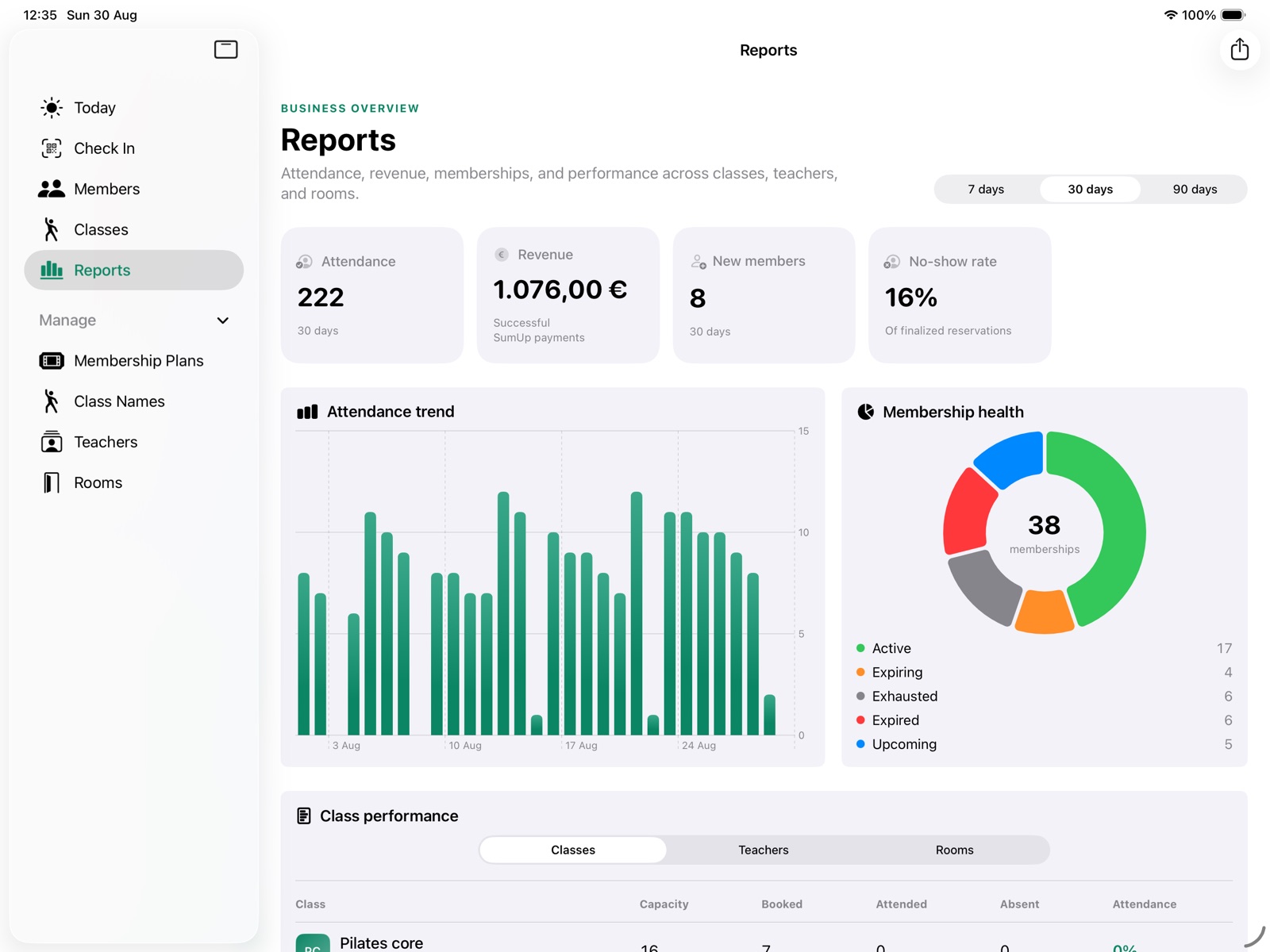
Collected totals use the paid date. Older paid records without a separate paid date use their recorded date. Outstanding balances remain visible regardless of the reporting period. Failed, unfinished SumUp, cancelled, and refunded payments do not count as collected money; complimentary memberships contribute zero.
Use Export CSV > Payments to share payment IDs, member and membership names, status, method, amount, currency, recorded/paid/due dates, reference, and note. The export includes activity in the selected period plus every current outstanding membership balance, even if older. Keep currencies and statuses separate when using the file; adding every amount would mix paid money with unpaid or unsuccessful records.
Attendance and class, teacher, and room performance exports remain available. CSV files can contain private customer data, payment references, and notes. Share them only with authorized recipients and store them securely.
Data and privacy#
- Member, membership, class, attendance, and payment-reference data is stored locally with SwiftData.
- Diagnostic logs must not contain member data.
- Card details are handled by SumUp and are not stored in the Members! database.
- Online synchronization and Wallet services require authenticated access to the secure Members! server.
- The current product does not yet provide a finished production backup service or full multi-device conflict handling.
Use device passcodes, restrict staff access, install trusted operating-system updates, and define an operational backup and recovery procedure before storing real customer data. Treat exported CSV files, member photos, contact details, notes, and attendance as private data.
Troubleshooting#
The camera is unavailable#
Open the iPhone or iPad Settings app, find Members!, and allow Camera access. Close other camera activity and return to Members!. On iPad, leave Member Mode before trying to use the rear owner scanner.
A member cannot check in#
Check that the member is active, the QR card is current, and a membership is within its start and expiry dates. Check remaining sessions and the weekday, weekend, and time restrictions. A payment-due membership must be settled through its existing Payments record; a cancelled membership cannot be used. Try the printed member code manually. If there is no usable membership or existing balance to settle, sell a plan or use the authorized SumUp walk-in payment flow.
A session was not deducted twice#
This is expected if the second scan happened within 90 seconds. Duplicate protection records only the first check-in and prevents a second session deduction.
The wrong membership was used#
Staff check-in offers a chooser when several memberships are usable. Select the intended membership before confirming the visit; only its sessions are affected. Member Mode automatically uses the usable membership that expires first. Review each membership's access rules, dates, and remaining sessions in the profile.
A printer is not found#
Confirm that the printer is switched on, connected to the same permitted network or paired with the device, and supported by the selected Epson or Star driver. Scan again. For Epson network printers, try the IP address or host name. For Star, verify the identifier on the printer information sheet. Print a test ticket before printing member cards.
A payment cannot start#
For a SumUp charge, open Settings > SumUp payments and check configuration, merchant connection, terminal pairing, network access, and account status. You can save a membership without SumUp by choosing a manual method under Paid now, or Pay later if nothing has been received. Do not create another purchase after an uncertain charge. First review the existing SumUp record in Payments and follow the recovery steps above.
Member Mode will not open or close#
Set a device passcode and enable Touch ID or Face ID. Confirm that the iPad front camera is available. Use the Owner button and authenticate. If Guided Access is enabled, leave it using the studio's approved device procedure.
Wallet or synchronization is unavailable#
The secure Members! server may not be configured or reachable. Local operations can continue, but do not promise a Wallet pass or completed synchronization until the server connection is restored and verified.
Support#
For help with Members!, email support@waiterone.net. Include the app version, device model, iOS or iPadOS version, and a description of what happened. Never email card details, passwords, authentication codes, or unnecessary member data.